
Scan. Fix.
Stay compliant.
Fast WCAG 2.2, ADA & Section 508 scanning — with a clear path to fix what matters.
- WCAG 2.2 AA
- ADA Title III
- Section 508
- PDF/UA
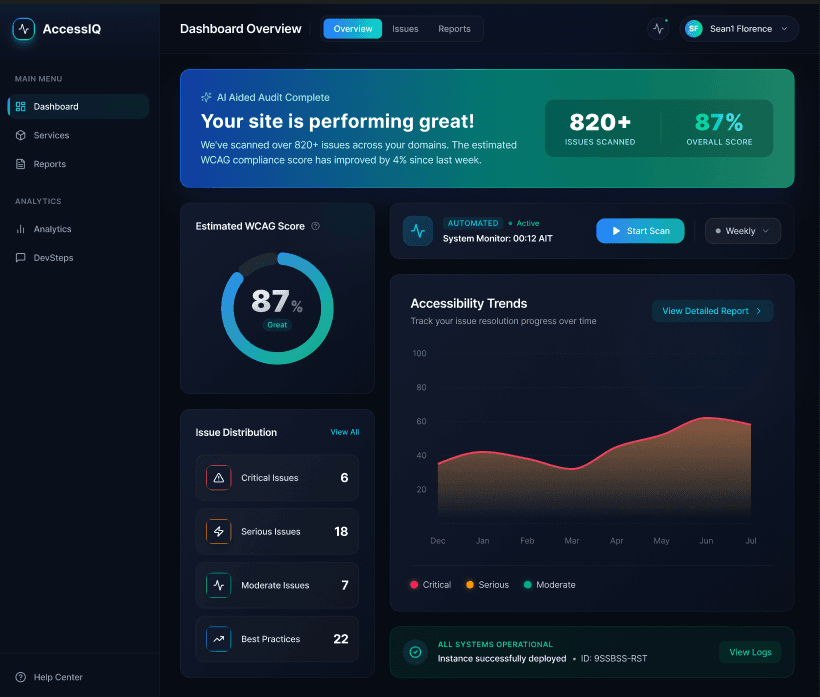
820+
Issues found
87%
WCAG score
< 60s
Scan time
Why Accessive
Minimal steps. Maximum clarity.
See real risk across your entire site
Not just a single page snapshot — find what actually creates exposure.
Prioritize what actually matters
Severity-first reporting so teams fix the issues that reduce risk fastest.
Turn findings into action
Developer-ready guidance — or hand it off to our experts for remediation.
Product preview
See what your site looks like to risk.
One scan surfaces critical issues, risk level, and the score your team can act on immediately.
Simulated result
accessive.app
Full-site snapshot · WCAG 2.2 mapping
Issues detected
87
Accessibility score
82%
Critical
12
Risk level
ADA / WCAG exposure
Pick a scanner
Three scanners, one workflow.
Start in seconds. No signup required.
The truth about automated tools
Scanners find 30–40% of real barriers.
Use automation to get started — then close the gap with expert review when you need legal confidence.
Automation
30–40%
Great for fast detection + a baseline report.
Human audit
60–70%
Catches what scanners miss: keyboard, SR flow, meaning.
How it works
From scan to action — four steps.
Start with a free scan. See your results in seconds.
Run free scanCompliance proof
Built for WCAG, ADA, and 508.
Reports map findings to the standards your legal and procurement teams recognize — without a wall of text.
WCAG 2.2 AA
The accessibility baseline used in U.S. enforcement.
ADA Title III
The legal framework most lawsuits reference.
Section 508
Required for U.S. federal agencies & contractors.
Start with a scan. Upgrade confidence only when you need it.
Start free scanYes — if you operate a website that serves the public in the US. Under ADA Title III, all businesses that qualify as a "public accommodation" must provide an accessible website. This includes e-commerce, healthcare, hospitality, law firms, and SaaS products — regardless of company size or revenue. There is no small business exemption. The DOJ's April 2026 deadline for public entities has already passed, and private sector enforcement continues to accelerate.
No — and this is critical. US courts have consistently rejected overlay tools as insufficient remediation. The FTC took enforcement action against accessiBe in 2025 for deceptive compliance claims. The National Federation of the Blind officially opposes overlay products. Overlays detect only 20–30% of WCAG violations — the remaining issues persist in your underlying code and create ongoing legal exposure. Accessive identifies the real issues in your code so they can be permanently fixed.
No automated tool can guarantee 100% compliance — and any tool that claims otherwise should raise a red flag. Automated scanners reliably catch approximately 30–40% of WCAG issues. The remaining issues require human judgment — things like whether an image description is meaningful, or whether a workflow is truly keyboard-accessible. Accessive combines automated scanning with expert manual audit services to close that gap. Our reports clearly distinguish what was found automatically from what requires human review.
Accessive scans against all four standards required for full US compliance coverage: WCAG 2.2 AA (international standard), ADA Title III (US private sector), Section 508 (US federal contractors and government vendors), and PDF/UA (accessible document standard). We also cover the European Accessibility Act (EAA) for organizations operating in the EU.
No. Scanning runs server-side on our infrastructure — your website's performance is completely unaffected. There are no scripts injected into your live site, no overlays added, and no impact on your Core Web Vitals or SEO scores. Your visitors never know a scan is running.
Still have questions?
Our team replies within 4 business hours.
Ready? It takes 30 seconds.
See what's broken — before it costs you.
Scan your website for free. No account, no credit card. Get a clear report — then decide what to fix.